What in the World is the World Cup?
With the World Cup happening in North America in 2026, it seemed like a good time to figure out what exactly the World Cup is. What is it? What is FIFA’s mysterious acronym? How many hit dice does a goalie have? Learn all of this and less!
I hope you enjoy this bit of nonsense. If you do, please sign up as a free member to receive future columns via email. If you really did, sign up for one of the paid tiers to get a whole lot of extra fun!
World Cup fever has once again gripped the globe (but not with its hands, I’ve learned, as that would earn the opposing team a penalty kick). I’m sure you’ve seen plenty of coverage of this massive event, but perhaps, like me, you’re left wondering…what is all this? Time to do some learning.
If you go to the website for FIFA, the organization responsible for The World Cup, it assumes a lot of things. It assumes you know what The World Cup is, who the sweaty people are all over the site, and what FIFA stands for. I’ve decided it stands for Fun Is Fun Always, because this is clearly about a sports and sports are meant to be fun.
I should say up front that I am not a Sports Person. This is not to say I have anything against sports, per se, although the knowledge that the National Football League generates $23 billion in annual revenue and the exact amount needed to eradicate emergency starvation and extreme hunger globally is between $7 and $23 billion doesn’t sit well with me. Perhaps if the starving kids all put on a show of chasing balls and bashing into each other, we’d have a solution!
Really, I don’t have anything against sports. I promise. I just don’t get it. And that’s okay. There are a lot of phenomena I don’t get that are wildly popular. Chicken wings are so much work for so little reward. Loud vroom vroom truck is apparently good truck. People listen to what Russell Brand has to say. There are a lot of mysteries to me in this big, shiny world.
But back to The World Cup.
As a child, I briefly played the game that Americans, Canadians, Australians, and New Zealanders stubbornly refer to as “soccer” but the rest of the world calls “football.” Because I am geographically an American, I will stubbornly continue to refer to the sport as “soccer” in an attempt to fit in. I wasn’t very good at soccer, as I recall, because my skills are more generally localized in my wit and hands and not so much in being able to run without falling down or kick things into other things or remembering aspects like rules. My primary memories of playing soccer consist of shin guards, a squeezy water bottle with a bizarrely long straw, delicious orange slices, and enjoying playing goalie because I was often alone on one end of the field and could drift off into my own world while the other children did sports at the other end.
Modern soccer, the game played in the mysterious World Cup, originated in England primarily as a way to play rugby without using your hands. Because this happened in 1863, I assume the British wanted their hands free so they could clap and cheer for the fact that America was in the middle of a pretty nasty civil war and was tearing itself apart. This was only the formal version of the game, as kick-a-ball-around games have likely existed for the entirety of humanity because it’s fun to kick and I’m sure there were plenty of objects to kick around back in caveman times. Melons and opossums and skulls, maybe.
In 1930, FIFA (Feet Is For Arugula) decided that the world was nice and stable and could use a global tournament to celebrate that lasting peace. They pulled together a whole pile of international teams, threw them into one general area, and called this event The World Cup. And unlike the lying name of The World Series, which includes teams from two thirds of a single continent, The World Cup has featured over 80 national teams since its inception from nearly every continent. At some point, the penguins of Antarctica will get their team into shape and join the fun, but to this point have yet to qualify.
Speaking of qualifying, that’s where The World Cup starts to get truly mysterious. Part of the reason the event is held every four years (aside from copying The Olympics) is that the qualifying stage can take up to three years before the final tournament. Within each continental region there are a bunch of running-and-kicking games and then those folks duke it out with other continental regions to see who will qualify for the Final Tournament.
For the Final Tournament, a host country is chosen (like, you know, The Olympics) and a whole bunch of soccer games happen across that country. For 2026, the host country is the United States (with assistance from Canada and Mexico), which is why all of a sudden a lot more Americans seem to care about soccer than they did, say, in 2025. The last time the U.S. hosted The World Cup was in 1994 and it was the most attended World Cup in history. Personally, I was unable to attend due to The Lion King opening the day before it started and sending me into a frenzy of drawing cartoon animals. Also some O.J. Simpson stuff was happening.
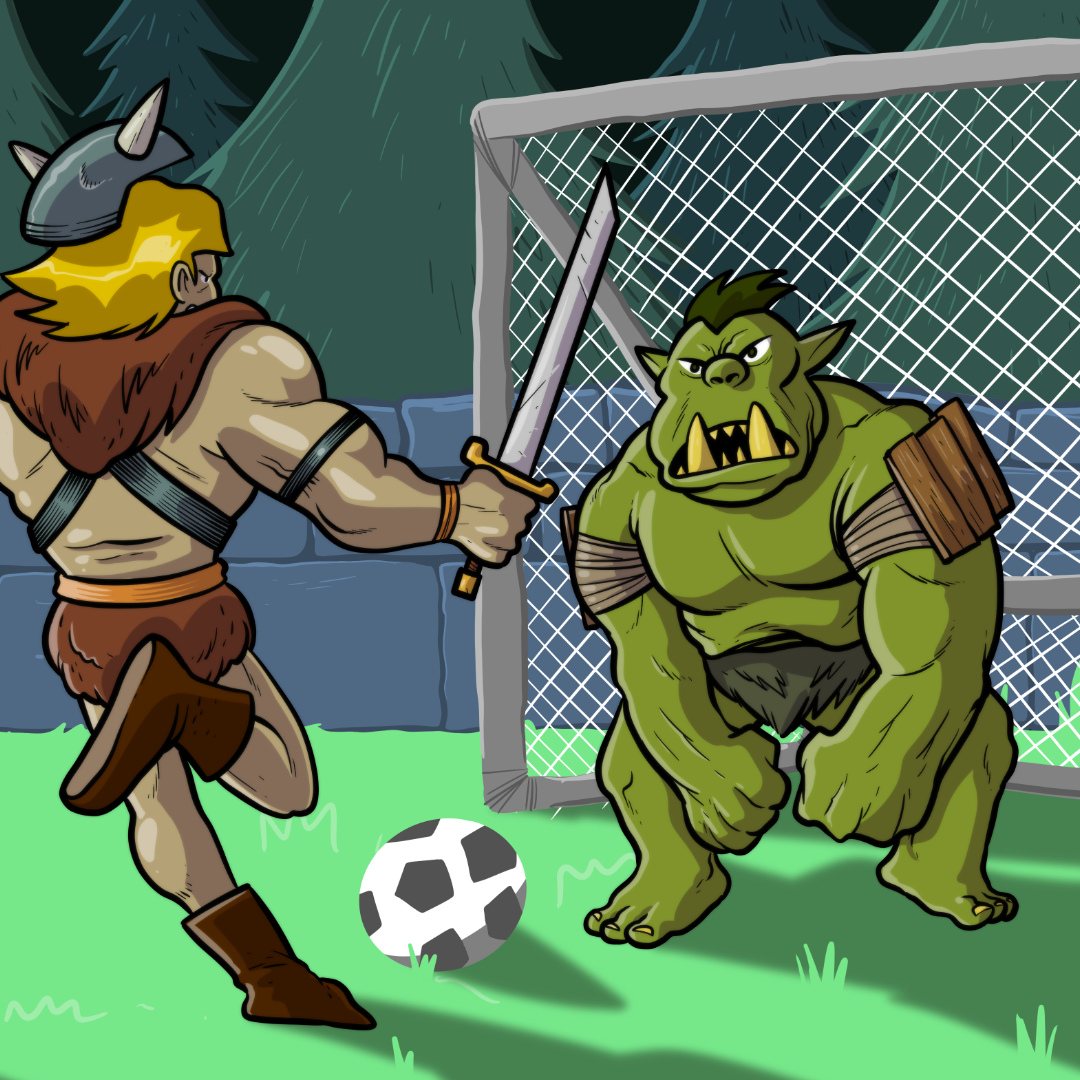
The Final Tournament is where the investigation starts getting murky. Unlike a lot of sports tournaments, where who wins and loses decides who ultimately super wins, everything is based on points that are gained by how many more goals one team has over another and lost by yellow and red cards. Then if a team has enough points, its ranking is determined by random chance. In Advanced Dungeons & Dragons, you earn and lose hit points and loot and battles and whatnot based on your numerical stats and the arbitrary rolls of certain dice. The World Cup is D&D, you nerds.
So I’ve gotten to the bottom of the mystery. The World Cup is a bunch of global soccer games (campaigns) played in a host country’s stadiums (basement) that are ultimately decided by each team’s numerical standing and roster (character sheets). And from what I’ve read, the DM (FIFA, or, Fido Is a Fluffy Animal) tends to make up rules as it goes along and each tournament is just a little bit different depending on its whims and/or whatever politician calls them to be sad about penalties.
The next World Cup following this writing will occur in 2030 and will be a celebration of 100 years of worldwide ball-kicking fun. It will be hosted across three continents, so I hope the players have packed enough snacks as they pile into the station wagon for the trip between basements.